
Will I Be Alone Forever?
What the Panic Is Really Telling You

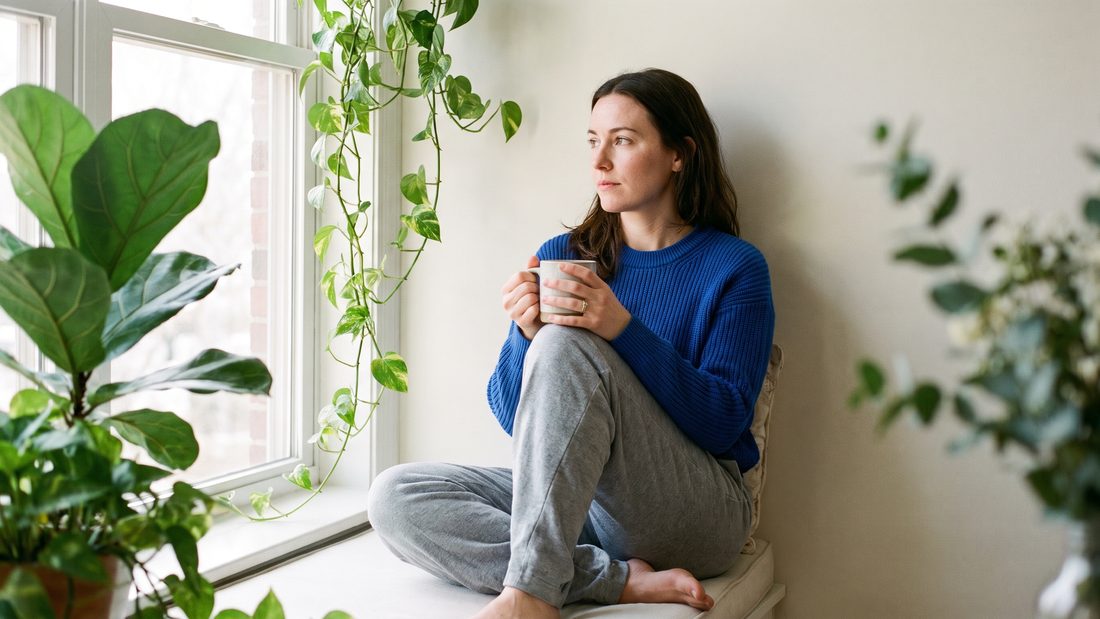
There is a particular hour when the question stops behaving like a worry and starts behaving like a verdict.
Have you had that hour? You are doing something ordinary, folding laundry, driving the last stretch home, and the sentence arrives fully formed. I am going to be alone forever. Do you then start gathering evidence for it, the years, the near misses, the friends who paired off while you were still trying? And does some quiet part of you feel almost relieved to stop hoping, because at least a verdict is restful?
If you recognized that hour, stay with me. The verdict is the least reliable thing in the room, and the panic underneath it is carrying information that is genuinely worth having.
None of this is a character flaw. Wanting to be loved is not a weakness you should have outgrown by now, and the fear of running out of time is one of the most common fears human beings carry. You did not invent it and you are not indulging it. You are feeling it because the stakes are real to you.
I'm Sansi Wilde, author of The Chosen Woman Protocol. I know that hour from the inside. For years, fear of the future kept me making excuses for a relationship that was costing me myself. When I walked away from it at thirty-eight, after ten years, I had no idea whether I would find love again, and for the first time ending up alone did not frighten me. Several years later I am in the best relationship of my life, one where I don't audition.
So let's look at what this fear can actually tell you, what it cannot predict, what it does to your choices when you are not watching, and what to do the next time it arrives.
What the panic is really telling you
The panic presents itself as a forecast. It speaks in the future tense, with total confidence, about events that have not happened. That confidence is the tell, because nothing in your life so far has given you the ability to see next year.
The panic tells you far more about what feels possible to you right now than about what will happen. Sometimes that feeling is shaped by an old belief about being lovable. Sometimes it comes from grief, from one disappointment too many, or from the very real pressure of time. Read that way, the sentence changes meaning. "I will be alone forever" often turns out to mean "right now, I cannot imagine being chosen," and that describes tonight's imagination, which is a much smaller thing than your future.
Here is where it gets useful. Have you ever been certain something would hurt for years, and found it had softened within months?
Psychologists Timothy Wilson and Daniel Gilbert have studied that gap under the name affective forecasting, the way we predict how future events will make us feel. People tend to overestimate how intensely and how long a future event will affect them, because they cannot see in advance how quickly they adapt and make sense of things. Your mind is predicting a lifetime from a feeling that can change much sooner than you expect.
So the panic is a reading of how you feel tonight, and that reading changes as you do.
Why do I feel like I am going to be alone forever?
Because the feeling has a job, and it is doing it badly but sincerely. Fear scans for threat, and the loss of connection registers as one of the oldest threats there is. When you have wanted something for a long time and not received it, your mind starts trying to protect you by preparing you for the worst version.
There is usually a trigger underneath the hour, and it is worth naming yours. A wedding invitation. A pregnancy announcement in a group chat. Watching a colleague get engaged while you are the one everyone assumes is fine on her own. You know the version where friends and coworkers get married while your own life seems to stay exactly where it was. The ache in that is the feeling of being left behind by a timetable you never agreed to.
There is often something older too. If you grew up learning that love had to be earned, or that you were most acceptable when you were useful, then being unpartnered does not feel neutral. It feels like confirmation. The panic often borrows its certainty from that older belief, which is why it arrives sounding so familiar and so true.
That belief is usually something you inherited, and it is no verdict on who you are. You absorbed it, and absorbed things can be updated. If the fear underneath your question sounds more like "there is something wrong with me," Will Anyone Ever Love Me? goes into that layer directly.
What are the chances of being alone forever?
There is no reliable percentage that can tell you whether you, personally, will stay single, and anyone offering you one is selling certainty dressed up as information.
Averages describe groups. They do not describe you, because they cannot account for what you will decide, where you will move, who you will meet once you are somewhere you have not been yet, or how you will change in the meantime. A statistic about how many people your age are single tells you about a population on a particular census day. It cannot tell the specific woman reading this sentence what will happen in her own love life.
What people usually want when they ask about the odds is not a percentage anyway. They want permission to stop bracing. So here is the more useful frame. The better question is what your current pattern makes likely, rather than how likely love is in general. A pattern is something you can actually look at, and change.
One more thing, because the internet is full of both extremes. Being told "you will find someone someday" by a person who cannot see your life can feel like being handed a receipt for something you never received, and you are allowed to find it irritating. The opposite claim, that some people are simply excluded from love, is just as unprovable and considerably more expensive to believe.
Are some people destined to be alone?
The idea that you are destined to be alone can bring a strange kind of relief. If it was decided in advance, then nothing you did mattered, and nothing you do next will matter either, which means you can finally stop hoping, trying, and risking disappointment. I understand the pull of that.
The trouble is what the story does after you accept it. Believing you are the exception can quietly change your behavior in a hundred small ways, and those changes then produce more evidence for the belief. You stop going. You stop mentioning to friends that you are open. You get sharper on first dates so nobody can surprise you. Then the year passes without anyone new in it, and the belief takes a bow.
You may have seen the line about there being no lid for every pot. Whatever truth it holds about people in general, it says nothing about you in particular, and it certainly does not mean you have been individually marked. You do not need certainty about love to keep your life open to it. Being unpartnered is a description of your circumstances, and circumstances have a way of moving when the person inside them does.
The "signs you will never find love" lists, and what they actually measure
These lists are everywhere, and reading them when you can't sleep can become a particularly punishing habit. They usually offer the same items: you are too picky, you self-sabotage, you are afraid of intimacy, you have unrealistic standards, you are always the friend.
Look at what those items have in common. Most of them take a current habit, fear, or circumstance and present it as a permanent trait. Habits and fears are among the most changeable things about a person, and none of these lists can reliably predict whether you will find love. A list of changeable habits cannot tell you how the rest of your love life will unfold.
There is one thing worth taking seriously that most of those lists leave out: the quiet expectation you carry into a room before anyone speaks. If you have carried a faint sense of ending up alone from long before anything began, as though nothing ever quite got the chance to start, you know this one. An expectation like that can be there before any disappointment is, and over time it shapes what you notice, how you respond, and which possibilities feel safe enough to pursue.
So if you want something more useful than a checklist, ask what you assume will happen before you walk into a room. That assumption is doing more work than your dating profile ever did.
What the fear of ending up alone is called
If you have searched this fear, you have probably met the word anuptaphobia, an informal label for an intense fear of being or staying single. It is not a standalone diagnosis in the DSM-5-TR, the manual clinicians use. Related terms, autophobia and monophobia, describe fear of physical solitude, which is a different experience.
Naming it can help, as long as the name stays in proportion. Feeling afraid that you may never find a partner does not, by itself, mean you have a phobia. For most women asking this question, it is an ordinary, painful fear that spikes at predictable moments and settles again, and having a word for the extreme end does not place you there.
It also matters what you do with the name. If the fear is running your days, if it is producing panic symptoms, if it keeps you in a relationship you know is harming you, that is worth taking to a professional who works with anxiety. Nothing you read on a blog, including this one, substitutes for that.
What the panic does to your behavior without asking permission
This is the part almost nobody talks about, and it is where the whole thing turns.
Fear does not stay in your head politely. It shows up in your face at the party, in the speed of your reply, in the tone of the message you send once the silence has gone on longer than you can hold. Loneliness can make you more sensitive to signs of possible rejection, so an ambiguous pause starts to feel like disinterest, and you respond to a rejection that was never issued. Then the interaction changes shape, and you have new evidence.
It goes in two directions, and you may recognize both. Some women grip: they overfunction, they audition, they hand over more than the situation has earned, hoping that enough giving will secure the outcome. Others withdraw: they decline invitations, keep their dating profiles deleted, or avoid showing interest even when they genuinely want connection, and the distance feels like protection. Either way the panic is choosing.
The gripping side has been studied directly. The psychologist Stephanie Spielmann and her colleagues, in a paper titled Settling for Less Out of Fear of Being Single, found that people who feared being single were more willing to settle for less responsive partners and to stay longer in relationships that satisfied them less. The fear does more than hurt. It can quietly change what you accept.
Here is the mechanism underneath, in plain terms. What you expect shapes what you notice, how you show up, what feels familiar, and what you are willing to accept, and through all of that it shapes the way you take part in your own love life. This is the practical meaning of the phrase I keep returning to. You don't attract what you want. You attract what you are.
I can hear the objection, because I had it. "So now the fact that I am alone is my fault too." No. Responsibility and blame are different things, and this distinction matters enormously. You did not cause other people's behavior, their timing, or their choices. What you can influence is the state you bring into your next conversation, and how you respond. That is the good news, because it is the one part of this that answers to you.
How to find the belief the panic is actually reporting
The previous section showed how fear can steer your choices. Now let's look at the belief that is often underneath it, and finding it takes one sentence.
Take the panic sentence exactly as it arrives, and add one word to the end of it. Because.
I will be alone forever because...
Then finish it, quickly, without editing for how it sounds. What comes out is almost never a claim about the future, which is what the sentence pretended to be. Often it is a claim about you, short, old, and unpleasantly familiar. Because I am too much. Because I am not the one men choose. Because something in me is difficult to love and everyone eventually finds it.
Sometimes it points somewhere else: to grief, to one disappointment too many, or to a practical worry about time. Let the answer be whatever it is. The point is to find what the fear is responding to, so you can answer that, instead of treating the whole sentence as a prediction.
That second half tells you what the fear is built around; the first half was only its weather report. When it is a real concern, such as time, it deserves a practical answer, and the section on children below gives one. When it is an old belief about you, keep going here.
Now ask one question about it, as though you were looking at somebody else's sentence. Is this something you concluded from evidence, or something you absorbed along the way, sometimes long before you were old enough to argue with it? Often it is an old memory, a repeated experience, or a message you took in over time. A parent's remark. A stretch of adolescence when you were the friend. Something a boy said that got repeated.
If no single source comes to mind, that is fine; you can still ask whether the belief is helping you today. If one does, finding it will not dissolve the belief on its own. What it can do is change its category, from a fact about your nature into an opinion somebody once had in front of you, and opinions can be examined in a way that facts cannot.
Then, and this is the part that actually moves anything, go and get one piece of evidence against it this week. Deliberately, out in the world. Something that would be slightly difficult to explain if the belief were true.
If the belief is "I have to earn love," try one small act of honesty without overgiving: show interest because you genuinely feel it, and leave the extra effort out. The evidence you are collecting is that you can act from self-respect and stay steady whatever happens next, which is the very thing that belief says you cannot do.
This is also where affirmations do their best work. An affirmation you don't yet believe can feel hollow when you repeat it, so start with a sentence that feels possible, a bridge sentence that only opens the door to something new, and let the more specific one come later. Pair it with that small piece of evidence from your own life, and the belief has two things working on it at once.
Will I be alone forever after a breakup or a divorce?
This is one of the moments when the question feels most convincing, and there is a reason for it. After a long relationship ends, you are not only grieving a person. You are grieving a future you had already furnished, and the mind fills that empty space with the worst available image.
The forecasting problem is at its most extreme here. In the first weeks after a loss, you are being asked to predict a life from inside the least representative moment of it. Whatever you conclude about your prospects in that period should be treated as weather, not climate.
What is true is that the ground rules change, and pretending otherwise wastes your time. If a marriage ended, the practical and emotional terrain is specific enough that dating after divorce is worth reading on its own. If you are still in the stage where the ache is the main event, how to get over someone you love deals with that first.
One note on timing. The panic is often loudest before you have rebuilt a daily life of your own. That is not a coincidence, and it is not solved by finding someone quickly.
When the fear is really about running out of time for children
For many women the panic is not about company at all, and treating it as though it were is why so much of the reassurance slides straight off.
Notice what the fear does when children are in it. The ordinary version of this fear is open-ended, and an open-ended fear can be survived by remembering that there is time. This version has a fence around it, and a fence changes the whole character of the thing. The panic stops sounding like a mood and starts sounding like a schedule.
Say the plain thing before anything else. Wanting that is legitimate. For some women, the fear of missing it carries real grief for a future they deeply want, and grief is easily mistaken for pessimism, including by the person feeling it. The confusion is expensive, because grief responds to being felt and pessimism responds to being argued with. Treat grief as pessimism and you will spend your energy arguing with something that only wanted to be acknowledged.
The specific danger is that a countdown starts doing your selecting. It changes who looks acceptable, how quickly you agree to things, and how much you agree not to see. It helps to separate two questions: whether you want to become a parent, and what kind of relationship you want to build. They deserve their own answers, even when time makes them feel inseparable, and I write about separating those two questions at more length in a piece of its own.
One practical note that belongs here as well. If the timing genuinely worries you, a doctor who knows your history can tell you far more about your own situation than any average on the internet. Reliable information will not remove the ache, but it lets you make thoughtful decisions instead of leaving fear to fill in everything you don't yet know.
"I have done all the work and nothing has changed"
I want to give this its own section, because it is the objection I respect most.
You have probably heard it: "work on yourself," "get some hobbies," when that is precisely what you have been doing for years. Therapy. Hobbies. The reading. The self-care. And still the same result, and now the additional insult of being told to do more of it.
If that is you, I am not going to tell you to work harder, and I don't think those years were wasted. Being single is no verdict on whether your inner work succeeded. If the same painful belief keeps returning despite everything you have done, that belief is the layer worth a closer look.
You can build an impressive life and understand every framework while still carrying the belief that you are not the woman men choose. Understanding that belief is a beginning. Changing how you respond when it shows up is the next step.
There is also a trap in the doing itself. It is possible to use self-improvement as a waiting room, a way to feel productive about a life you have quietly put on hold until the relationship arrives. If any of that stings, Why Am I Still Single When I've Done All the Work? takes it apart in more detail.
What to do the next time the panic arrives
Not a program. Four things that help you respond differently when the panic arrives.
Date the sentence. When "I will be alone forever" appears, begin it with "right now, I feel like." The sentence becomes "right now, I feel like I will be alone forever," which is true, and which you can survive. The undated version claims to know the future. The dated one only claims to know tonight.
Ask what happened in the last day. The panic usually follows a trigger, even when you don't recognize it right away. Find the trigger, the invitation, the photo, the silence, the anniversary. Naming the trigger takes the sentence out of the realm of prophecy and puts it back into the realm of cause and effect, where it belongs.
Do not make decisions in that hour. Not about a man, not about deleting an app, not about giving up, not about accepting far less than you want because at least it is something. The hour is a bad advisor. Let it pass and see what you still think in daylight.
Then look at one behavior, not your whole worth. Pick a single thing the fear has been choosing for you. The invitation you keep declining. The message you rewrite until it sounds unbothered. The way you audition on first dates. Change that one thing this week and watch what happens to the feeling. Fear tends to lose its hold once the behavior it has been driving starts to change.
If the fear is bigger than an hour, if it is constant, if it comes with panic symptoms or thoughts of harming yourself, please treat that as a signal to get real support from a professional rather than a problem to solve alone with an article.
How to stop thinking about being single every single day
You cannot argue yourself out of it, and most women have already tried. Attention does not respond well to being forbidden.
What attention responds to is competition. Sometimes being single occupies so much of your attention because other parts of life have been put on hold until a relationship arrives.
The trips you are not taking until there is someone to take them with. The apartment you have not made beautiful because it feels like a consolation prize. The friendships you let thin because everyone else is busy with families. When one area of life is the sole open question, the mind will circle it endlessly, because there is nothing else in the room.
So the practical move is to give your attention somewhere legitimate to go. Not as a distraction technique, and not as the tired advice to get a hobby. As an actual reclaiming of the years you are currently spending in a waiting room.
The second move is smaller and stranger. Notice how often you narrate your own singleness to yourself during a normal day. The comment about arriving without a plus one. The joke about dying with cats. Those lines feel harmless because they are funny, and they are also the most consistent message you receive about yourself all week.
How to accept it without giving up on love
There are two things people mean by acceptance, and they lead to opposite lives.
One is resignation. You decide it will never happen, you close the door, and you get a temporary peace that costs you every future you have not lived yet. It feels like maturity and it can function like a shutdown. When it grows out of fear, it also closes off possibilities you still care about, and that is usually how you can tell it apart from a calm decision.
The other kind is real. You accept that you cannot control the outcome and you stop making today conditional on it. You stop postponing your own life. You keep the door open without standing at it. This is often the point where dating starts to feel lighter, for an ordinary reason: the pressure that was leaking into every interaction is no longer there.
The distinction shows up in behavior. Resignation stops going out. Acceptance goes out for the reasons that were always good, and lets meeting someone be a possibility rather than the point. One thing worth remembering is that a woman can build a life that is genuinely good on its own, and want a partner in it, and both of those can be entirely true at once.
If the practical side is what you need next, where to meet men in real life covers it without the performing.
The fear of being alone rarely stays a thought. Over time it turns into a pattern in the way you pursue love, protect yourself from it, or respond when it shows up, and a pattern can be named.
Frequently asked questions
Is it okay to be alone forever?
Yes, and it is also okay to not want that. A life without a romantic partner can be full, connected and meaningful, and plenty of people build exactly that on purpose. Choosing solitude and bracing for it feel different, and you can usually tell which one you are in. There is also a third place to stand: accepting that you are single today without deciding it is forever. You can want a partner, keep room for that, and still build a life that feels meaningful now.
Will I ever stop feeling alone?
Feeling alone and being single are two separate things, which is why partnered people report loneliness too. The feeling responds to connection of many kinds: close friendship, family, community, being genuinely known by someone. It also responds to how you talk to yourself when nobody is around. So the honest answer is that the feeling can ease considerably, and it does not wait for a relationship to do it.
What happens if you never find love?
Wanting someone to share your life with is a real desire, and you don't have to shrink it. A life without that partnership could carry real sadness, and it could still hold close friendship, family, meaningful work, and people who know you well. What deserves less of your trust is the picture your mind paints of that life on a bad night, drawn with none of the facts. You do not have to settle the question before you start living the life in front of you.
Is it bad to be single for a long time?
It is not a defect, and the length of time carries no verdict about your worth. What a long stretch can do is quietly build habits, a certain self-protection, a sharper reflex to leave first, a comfort in your own routine that leaves less room for another person. Those are worth noticing, and they are adjustable. Time alone is not the problem. What you concluded about yourself during it can be.
What if I never find love again?
That fear belongs to someone who has already lost something, so the first thing I want to say is that the grief underneath it deserves attention before the forecast does. What people usually mean by "again" is a specific love, with a specific person, and that particular thing is genuinely gone. Whether love in general is gone is a claim your mind is making from inside the worst chapter, without access to any of the pages after it.
If fear has been shaping your choices in love, naming what lies beneath it is the beginning, and The Chosen Woman Protocol walks you through the rest in order, working with the beliefs and emotional patterns at the root, from remembering who you are to receiving love from steadier ground.
When the panic last arrived, what were you doing in the minutes right before it? Write it below if you are comfortable sharing. Naming the trigger out loud does more than you would expect, and I would genuinely like to know what brings that fear to the surface for you.
yours, Sansi
Join the conversation
Loading comments…